

Web Insights · Mobile App Insights · Lucy Greider · May 2026
3 Times Web and App Data Were Better Together
Learn how you can connect web and app data to create a deeper understanding of your audience and how to reach them — with data from Web and Mobile App Insights.

Peanut butter and jelly, Spongebob and Patrick, web and mobile. Some things are just better together — that’s a fact. In a world increasingly dominated by smartphones (and apps), too many brands neglect this still-crucial sector of the digital economy. If you can understand the ways in which audiences move from mobile to web, and how their engagement patterns diverge across platforms, you’ll already be better-situated than 90% of the competition.
Here are three concrete examples of how integrating web and mobile insights into one unified strategy can bolster your competitive advantage.
Example 1: Evaluate True Audience Reach
Say you’re a major streaming service, and you need to assess the relative market share of your top competitors. If you had a Mobile App Insights subscription, you’d probably gravitate towards the Monthly Active Users report as a gauge for evaluating your peers’ hierarchy within the space.
Pulling up the OTT Streaming apps with the most MAUs over the past six months, this graph appears:
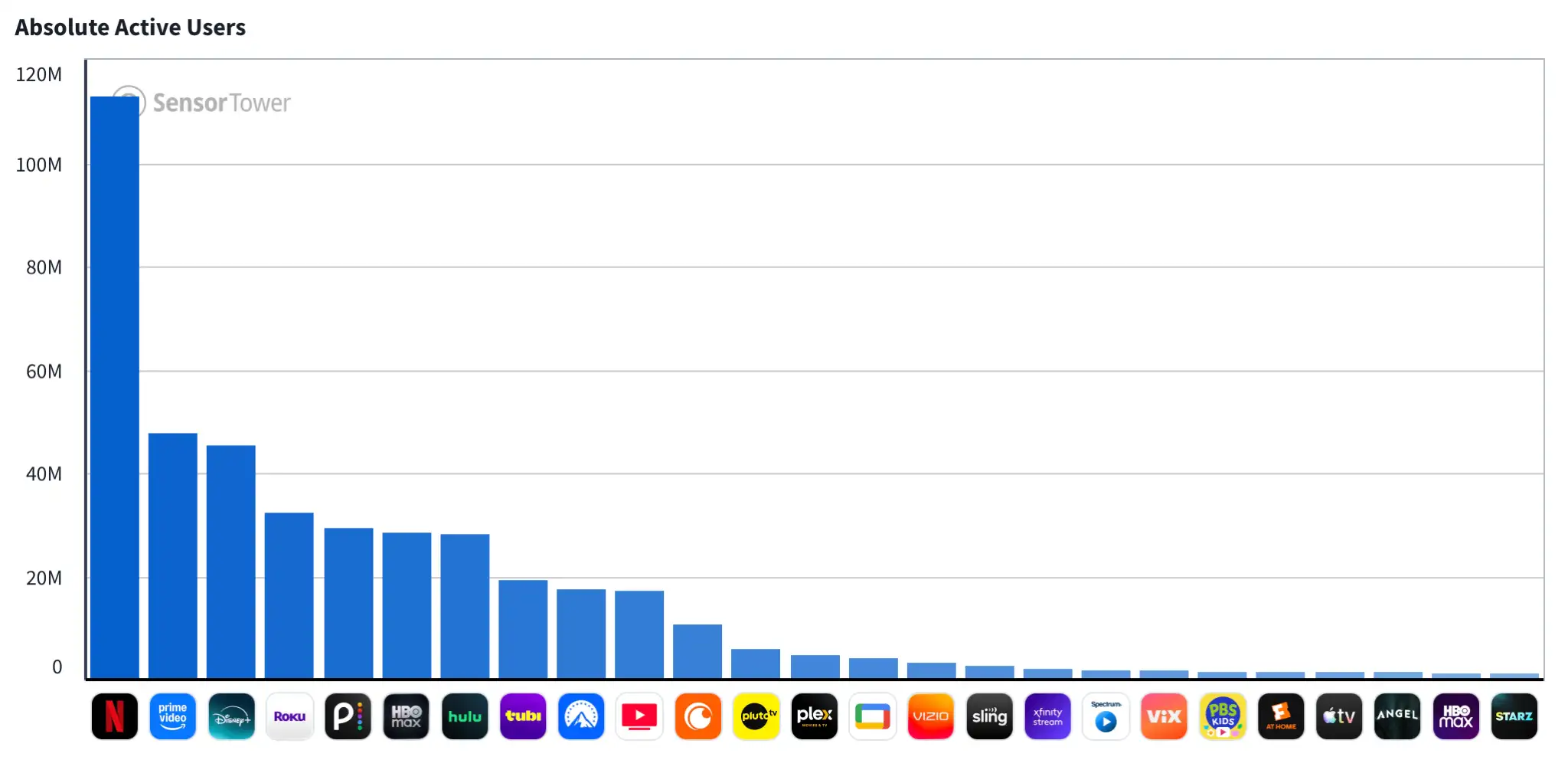
In the absence of further information, you’d likely conclude that the order of influence goes like this:
Netflix: 113M monthly active users
Prime Video: 48M
Disney+: 46M
Roku: 33M
Peacock: 30M
However – when we introduce web users to the equation, the hierarchy shifts:
Netflix: 24M (no change in ranking)
Disney: 10M ( ⬆️ 1 spot)
Peacock: 7M ( ⬆️ 2 spots)
Prime: 5M ( ⬇️ 2 spots)
Roku: 3M ( ⬇️ 1 spot)
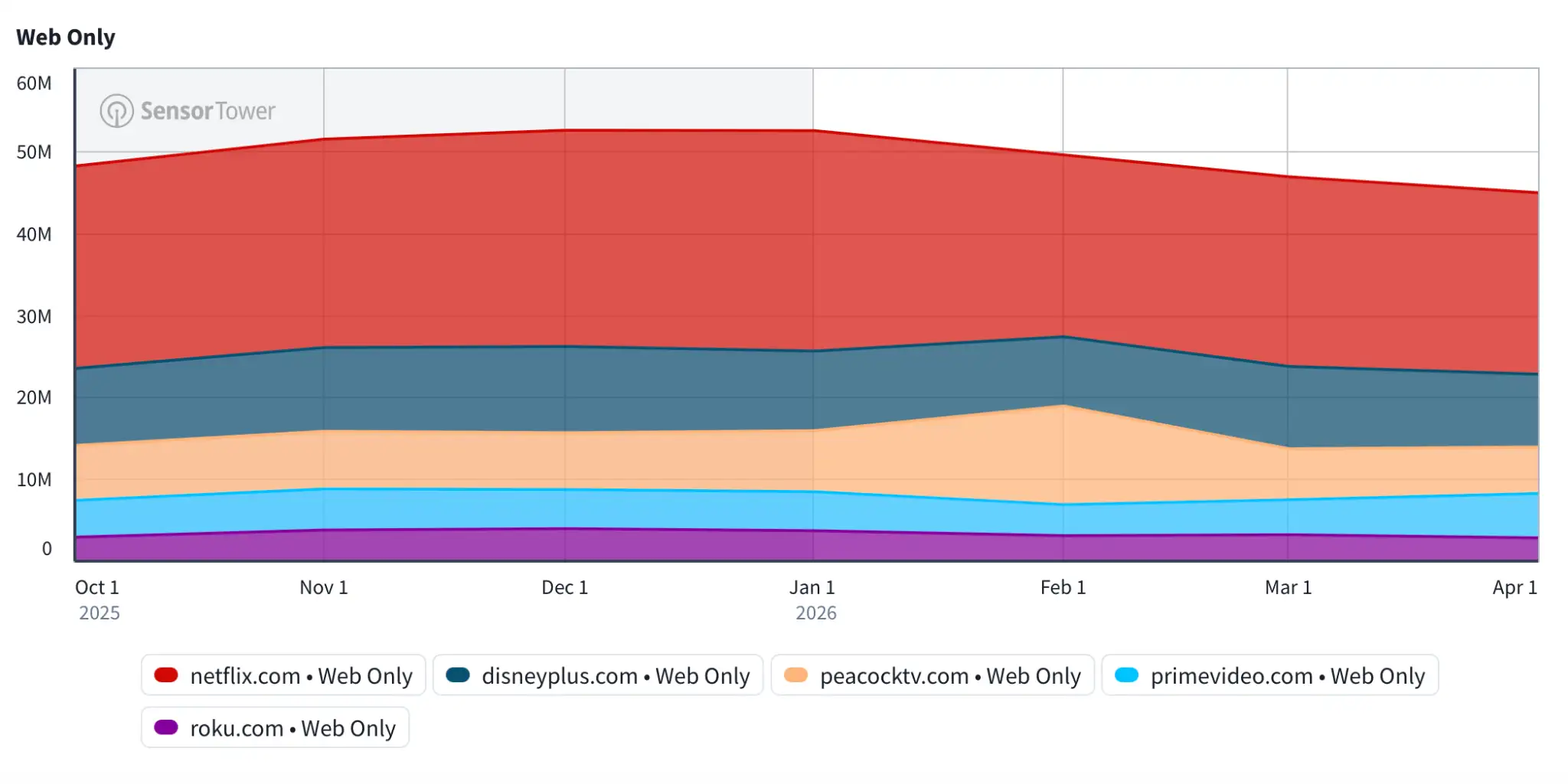
These are the users who interact only with a given brand’s website, and not their app. In this realm, Prime Video loses its second place spot and slides to #4. Meanwhile, Peacock moves up two spaces. Similarly, Roku slides down one spot while Disney rises from third place to second. Already we are seeing that the audience distribution of web-only users is distinct from what was observed in the mobile user-only chart. The order of influence shifts notably depending on the platform. But the last reveal is where we get to the heart of things. Behold, True Audience.
This is what the competitive field looks like when users are deduplicated, showing only the net number of human beings actually interacting with your brand across web and app, sans any double counting of individuals who access both. This is the metric that can reshape the whole narrative.
Here, the order of influence shifts again, and this is the final scale we end up with:
Netflix: 139M
Disney+: 56M
Prime: 53M ( ⬆️ 1 spot)
Peacock: 37M ( ⬇️ 1 spot)
Roku: 36M
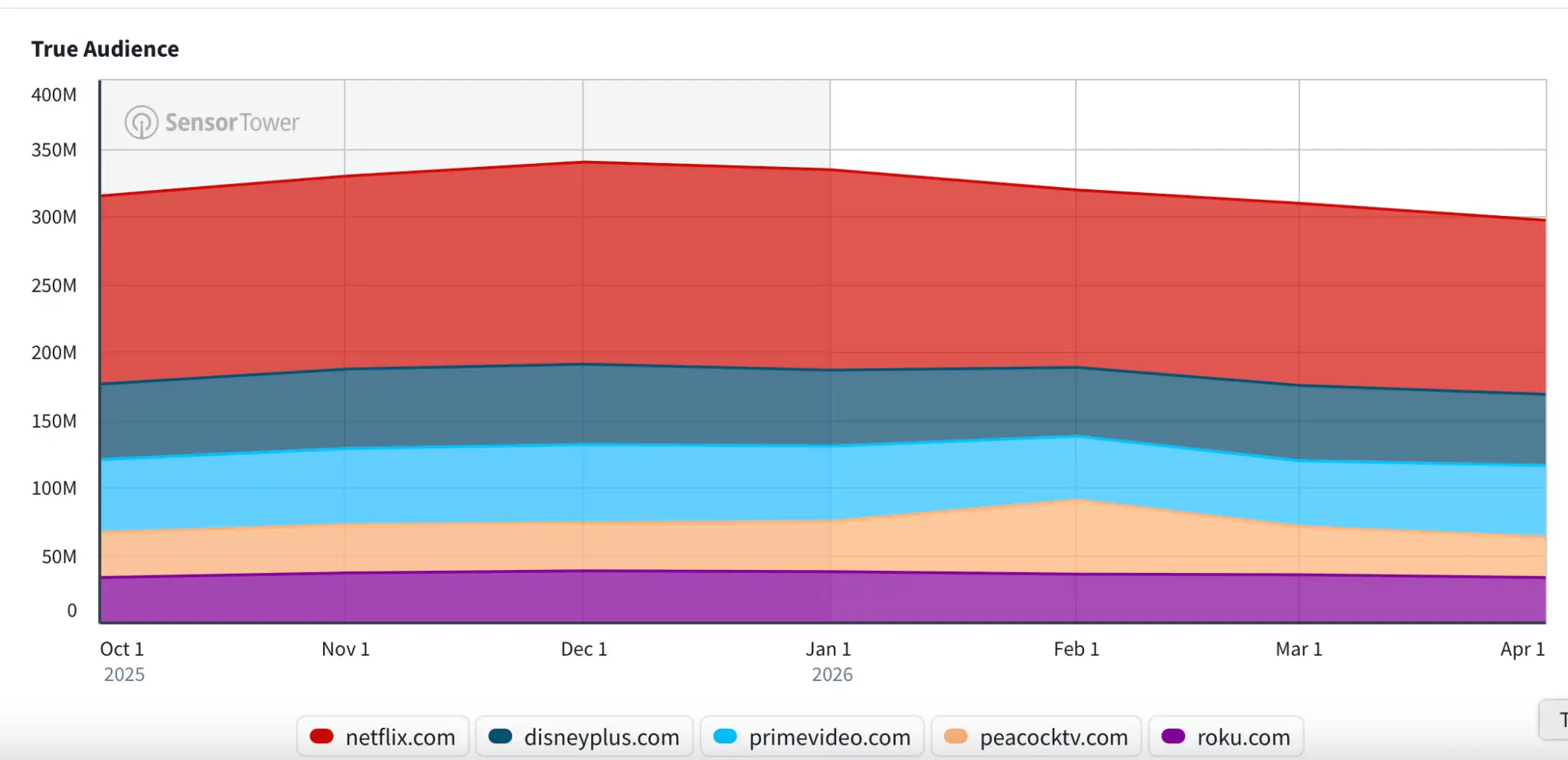
Netflix retains its top spot in each report — but the runners-up change rankings depending on which audience metric they’re being evaluated on. For example, you can see that the light orange and light blue slices representing Peacock and Prime switched places when measuring True Audience.
If the CEO of Prime Video were to make business decisions solely based on information in the first report — Monthly Active Users on mobile — they would be missing crucial context. On mobile apps alone, Prime looks like a secure #2, beating Disney+ by 4% and crushing Peacock by 60%. On the web, that reality flips completely. Disney+ has double Prime’s audience, and Peacock easily beats Prime with 7M users to Prime’s 5M. Finally, when you deduplicate the data and look at True Audience, Prime Video’s false sense of security vanishes. Disney+ claims the real #2 spot (56M), leaving Prime in third place with 53M.
For Prime Video’s strategy team, this gap is the difference between uncontested market dominance (leaving aside Netflix) and a brand quietly being usurped.
And this dramatic reshuffling of market share isn’t a quirk unique to the streaming wars. Across the entire digital landscape, relying on siloed, single-platform metrics forces companies to make multi-million dollar decisions in a vacuum. Consider how this knowledge gap plays out in the world of children and family shopping.
Example 2: Surface Hidden Contenders (Beyond the App Charts)
Now imagine you’re the purveyor of a new line of toddler-aged clothing, and you need to find the best venues for advertising and partnerships. A good place to start would naturally be the family shopping apps with the highest absolute downloads in the United States over the past year. Here’s what the chart displays:
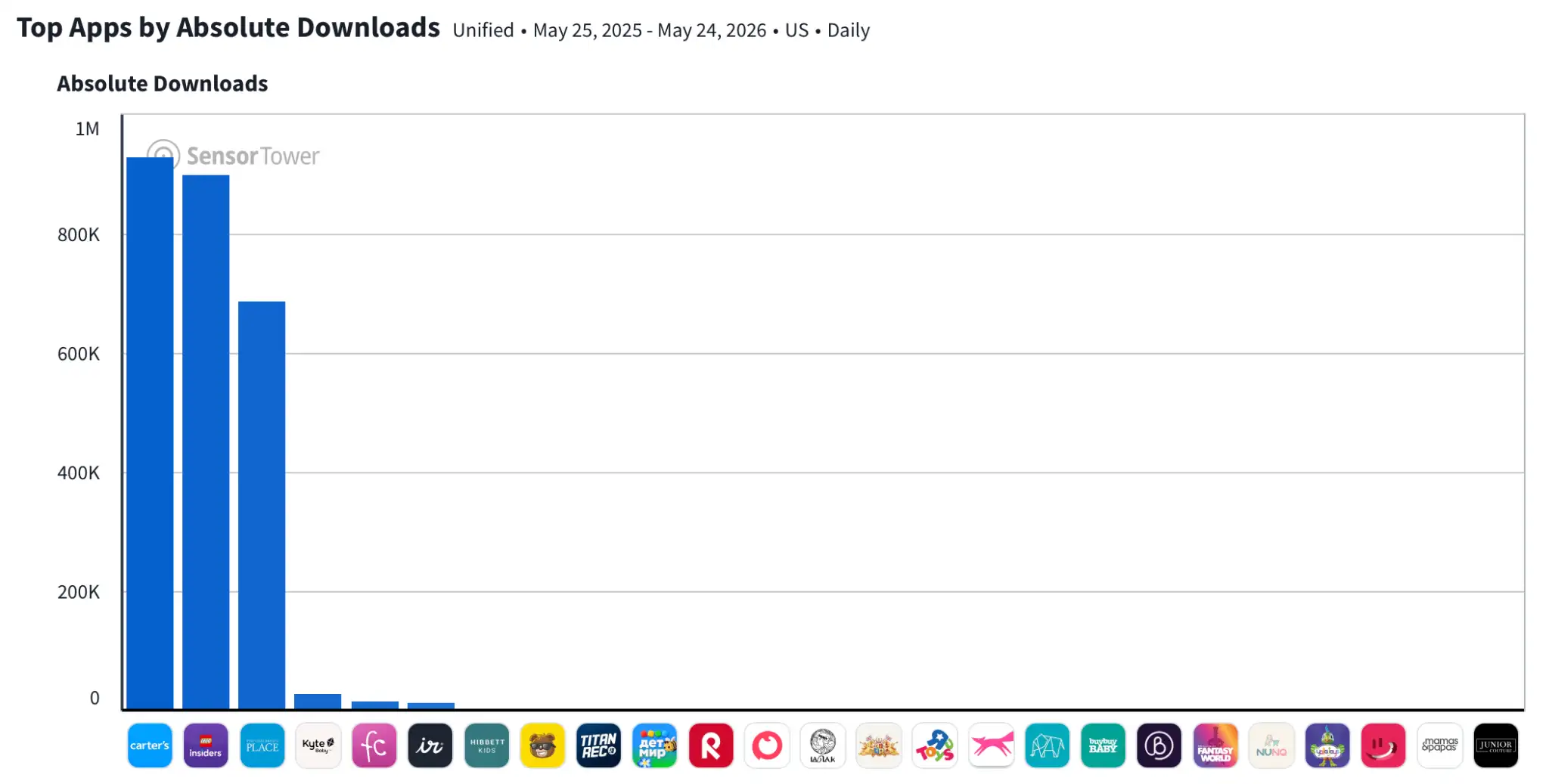
From clothing brands to toy stores, there are plenty of worthwhile partners in this list. However, without web data, you’d be missing an entire sector of the family shopping market that is absent from the mobile charts.
Now we’ll introduce the top family shopping websites over the past year, ranked by total number of visits. Here’s what the data shows:
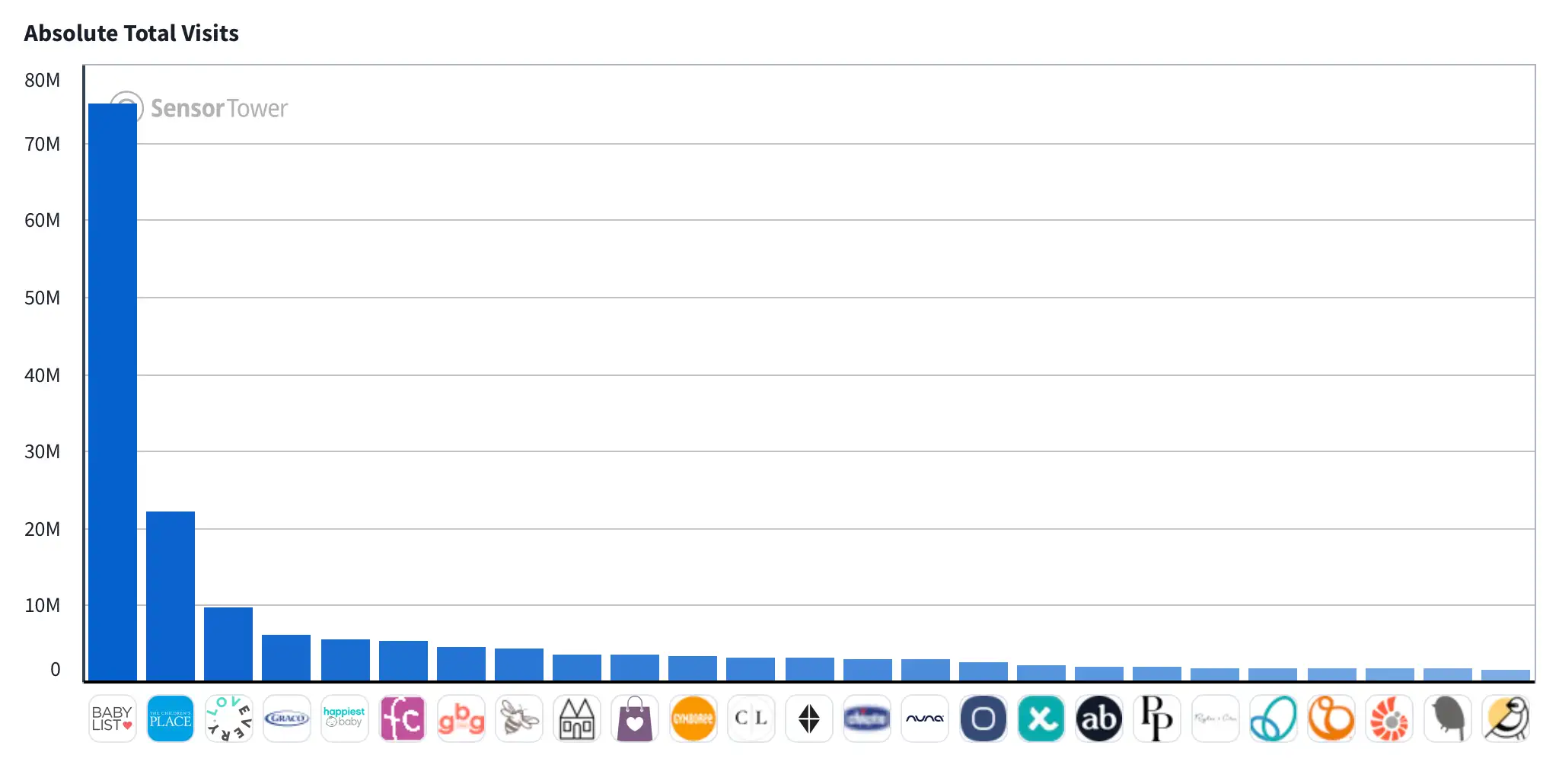
Only three of the twenty-five brands exhibited here (Children’s Place, Kyte Baby, and FirstCry) also show up in the list of top apps. When you expand your search to include parenting brands that dominate on web but don’t have as much of a mobile presence — and vice versa — you open yourself to a wider audience, and a different cohort of consumers. It’s easy to assume that contenders within a given vertical will remain consistent across web and mobile, but oftentimes that is not the reality. In this instance, combining web and app data not only reveals a different pecking order, but actually surfaces entirely new contenders that would have been completely hidden if only looking at one or the other.
Example 3: Break Down Platform Mix & Engagement Strategies
Finally, combining web and app data provides unique insight into how competitors variously prioritize different channels in their acquisition and engagement strategies. Here, we’re looking at the relative percentage of users that brands court on web versus app, rather than the absolute volume of their True Audience.
Say you’re a news outlet performing research on your competitors. Mobile App Insights can tell you who has the most downloads, or the highest app user base. But here you need a different kind of report: something that shows the distribution of users across platforms.
Web Insights can show you the percentage of visitors who interact with a brand only on web, only on mobile, or on both — displayed below for top news outlets:
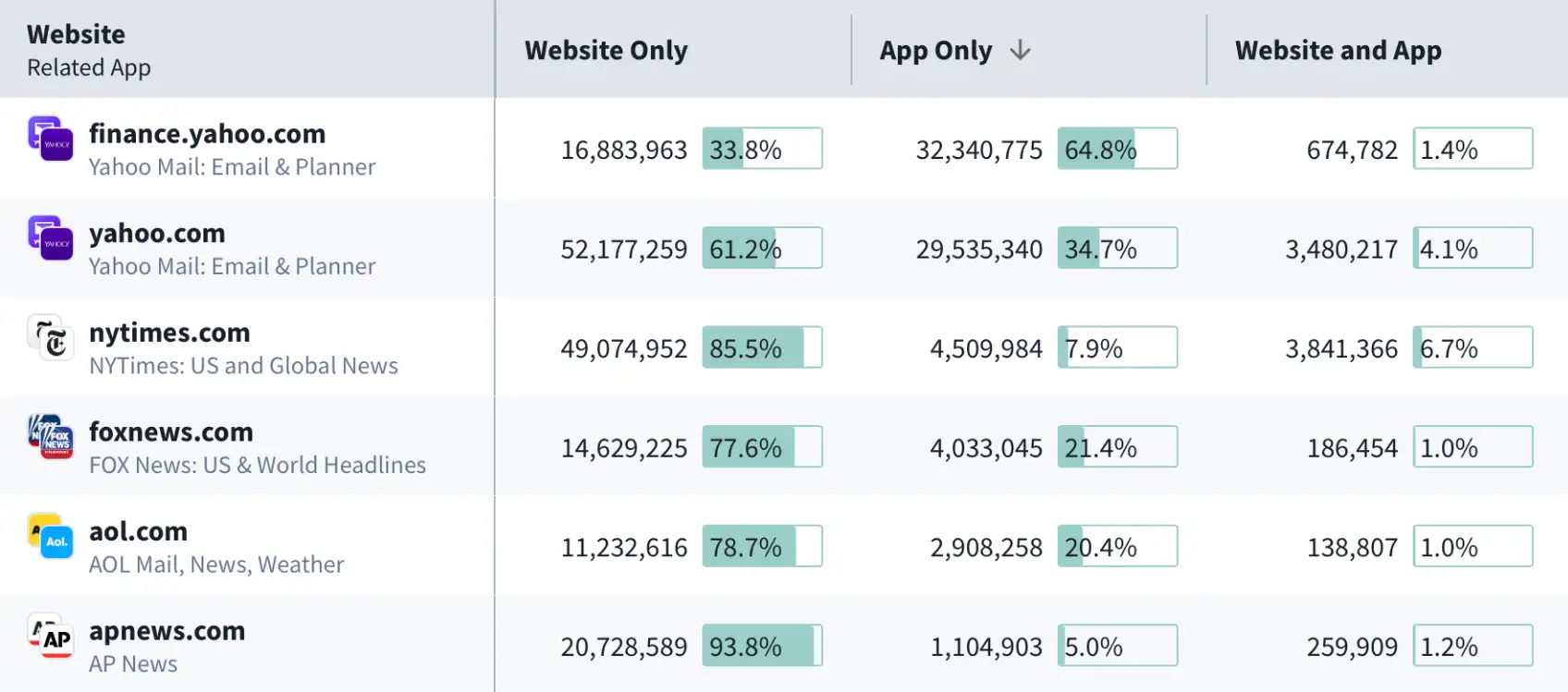
Now you can see, for example, that AP News (93.8% web-only) and the New York Times (85.5%), despite their large audience bases, are two of the least mobile-forward competitors. Meanwhile Yahoo and Yahoo Finance maintain a formidable mobile presence, and Fox News and AOL fall somewhere in the middle. What does one do with this information? Act on it.
If you’re competing with AP News and the NY Times, for instance, you might recognize that their web dependency makes them more reliant on the whims of search engine algorithms, and simultaneously target their audiences with app-based campaigns — knowing they may still be in the market for a mobile news experience.
Put concisely? Absolute audience size tells you who’s winning. The web/app split tells you how they’re winning, as well as where their vulnerabilities may lie.
Taken together, these three examples make the case for analyzing performance holistically across both platforms. In their own ways, each instance shows how broadening your dataset to include both web and mobile enhances or transforms the narrative in a significant way.
Get the full picture by combining Mobile App and Web Insights.
