
Digital Advertising Insights · Web Insights · Mobile App Insights · Rui Ma · October 2026
State of Automotive & Mobility 2026: Chinese Automakers Accelerate Global Expansion as Digital Customer Acquisition Emerges as a New Growth Driver
In 2026, leading Chinese automakers such as Geely are accelerating their overseas expansion, leveraging localised digital advertising strategies to differentiate themselves across international markets. As the industry evolves, automotive brands are shifting beyond traditional vehicle sales toward digital customer acquisition, with mobile and web ecosystems becoming increasingly important drivers of brand growth.
In 2026, leading automakers are facing increasing growth pressures in their domestic markets, prompting them to accelerate overseas expansion through localised digital advertising strategies tailored to different markets. The global automotive industry's energy transition is entering a multi-pathway phase, with hybrid vehicles emerging as a key transitional solution for many automakers in international markets. As automotive brands expand globally, their strategies are evolving beyond traditional vehicle sales toward digital customer acquisition, with mobile and web ecosystems becoming increasingly important drivers of brand growth.
Note: Download figures in this report are based on estimates from the App Store and Google Play, excluding pre-installed apps, repeat downloads, and downloads from third-party Android app stores. For more insights, click the button below to access the full report for free.
China Market: Premium Domestic Brands Defy Market Headwinds, While Exports Emerge as a Second Growth Engine
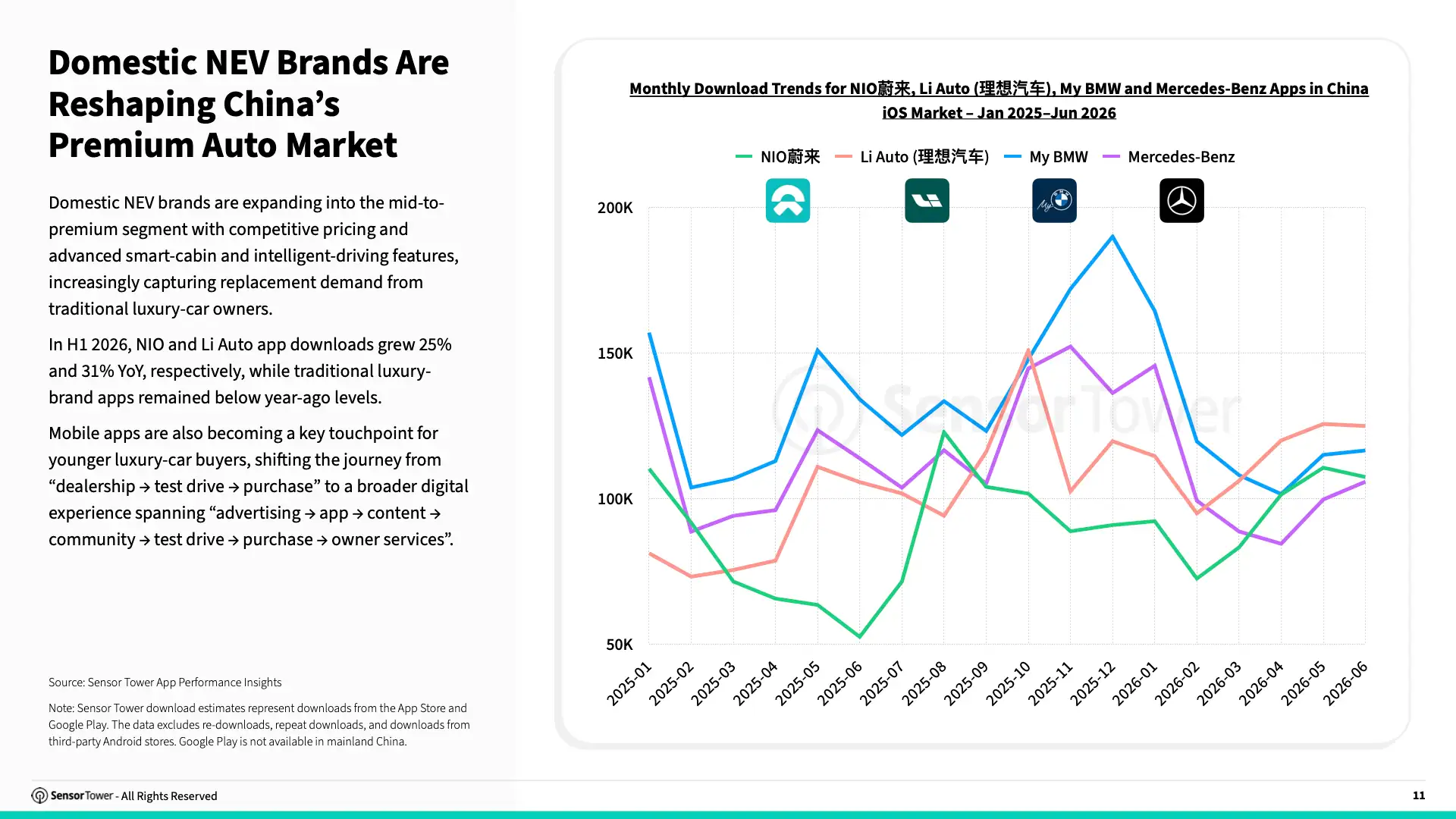
In H1 2026, China's passenger vehicle market faced continued pressure, with new energy vehicle (NEV) sales declining 17% YoY. However, premium domestic NEV brands continued to penetrate the mid-to-high-end market, leveraging competitive pricing, advanced smart cockpits, and intelligent driving technologies. These advantages are increasingly attracting consumers upgrading from traditional luxury gasoline-powered vehicles, reshaping China's luxury automotive landscape.
In terms of mobile app downloads, NIO and Li Auto recorded significant YoY growth of 25% and 31%, respectively, in H1 2026, while traditional luxury automotive brands remained below their levels from the same period last year.
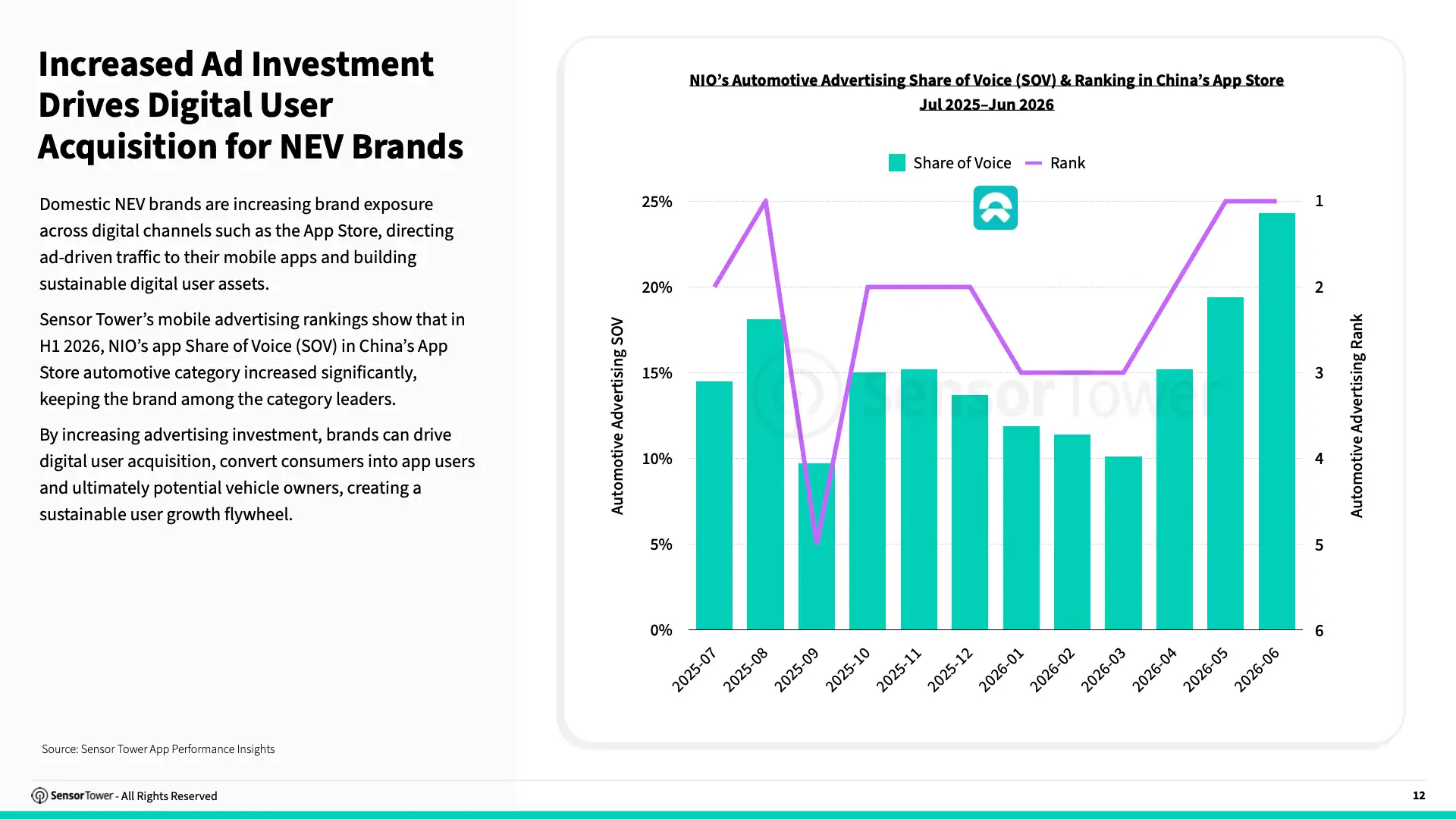
Domestic NEV brands are ramping up digital advertising investments to expand brand visibility and audience reach. By leveraging mobile channels for efficient customer acquisition, they are converting online traffic into active platform users and vehicle buyers, building long-term digital customer assets and creating a sustainable cycle of user growth.
Exports are emerging as a second growth engine for China's automotive industry. In H1 2026, passenger vehicle exports exceeded 4.43M units (+71.7% YoY). New energy vehicles (NEVs) became the key driver of overseas growth, with exports surging 130% YoY and surpassing gasoline-powered vehicles in share, marking a shift toward NEV-led global expansion.
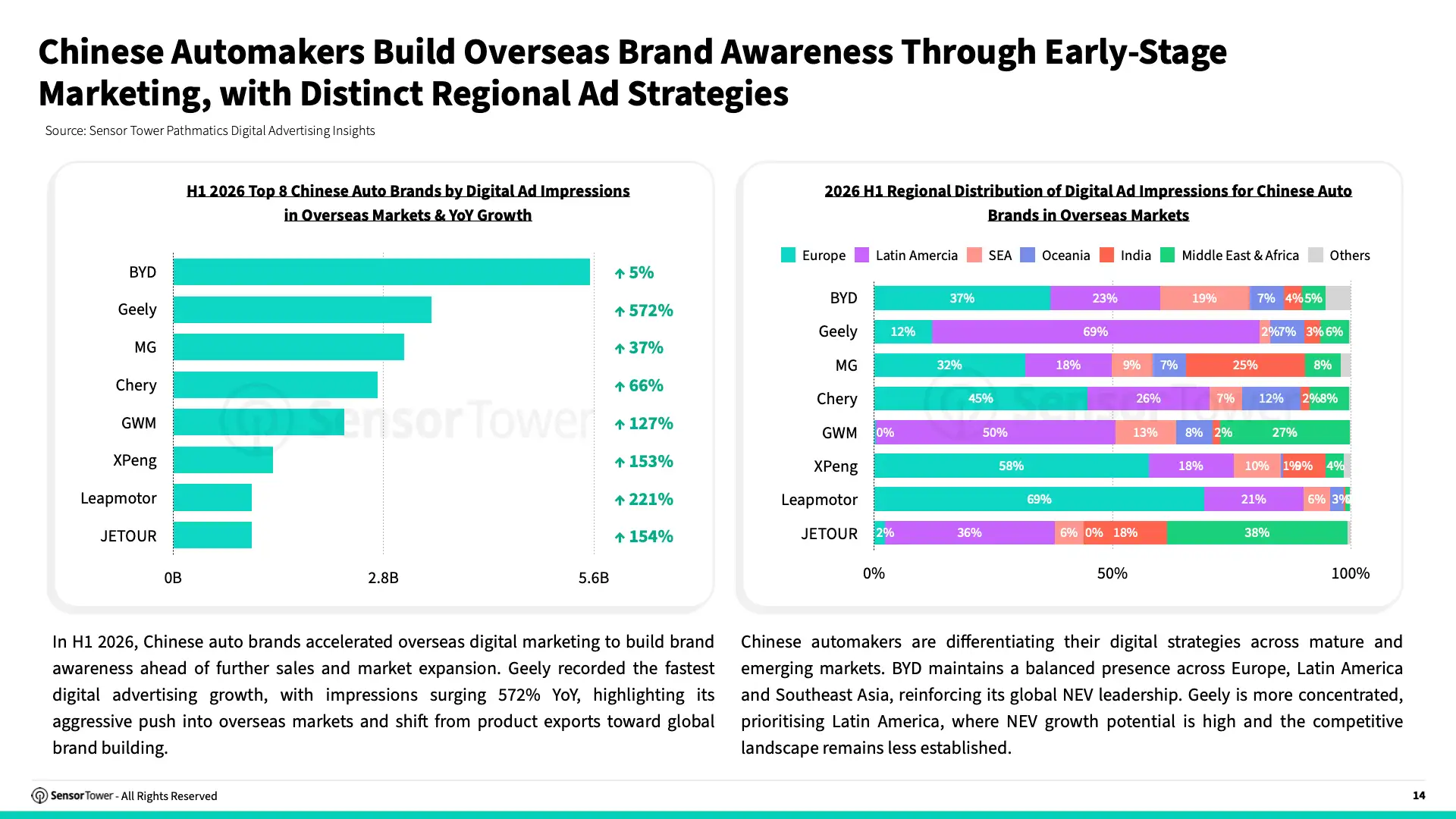
Chinese automakers are accelerating overseas digital marketing investments to support future sales growth and market expansion. Geely's overseas digital ad impressions surged 572% YoY, with Latin America accounting for nearly 70%. This highlights Geely's aggressive push into international markets through digital advertising, supporting its transition from exporting vehicles to building a global automotive brand.
Japan Market: Domestic Brands Lead with Diverse Powertrain Strategies, While Websites and Mobile Apps Become Key to Digital Ecosystem Engagement
In H1 2026, domestic automakers continued to dominate Japan's automotive market, characterised by strong hybrid demand, resilient kei car sales and early-stage EV adoption. Toyota outperformed the broader market through its extensive product portfolio and hybrid leadership. Meanwhile, Suzuki remained Japan's second-largest automotive brand, gradually expanding beyond kei cars into the compact passenger vehicle segment.
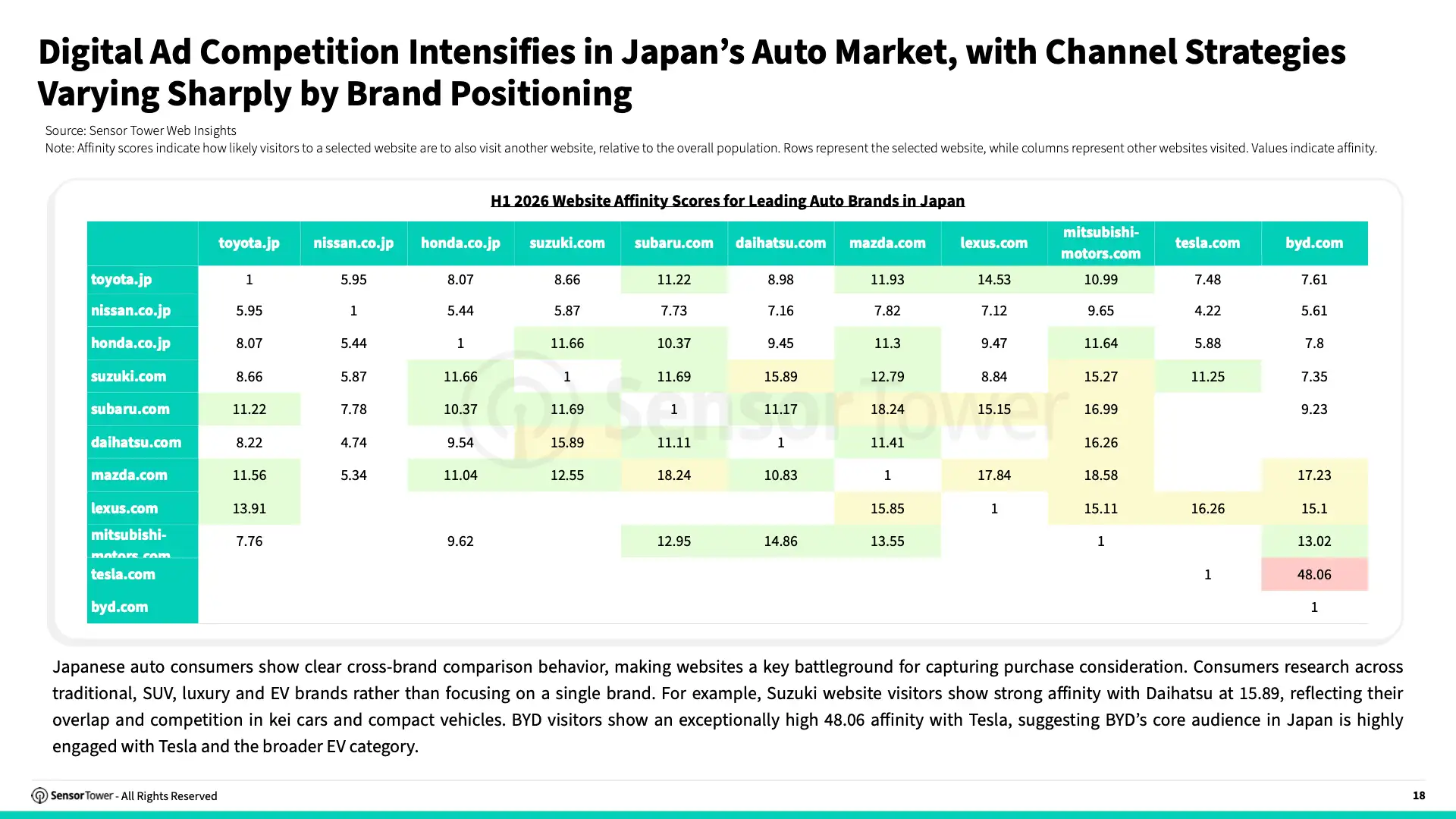
Websites are becoming a key battleground in Japanese consumers' vehicle purchase journeys, as users increasingly compare brands across mainstream, SUV, luxury and EV segments. Notably, BYD's website visitors showed a high affinity score of 48.06 with Tesla's website, indicating that BYD is attracting consumers who are already actively exploring fully electric vehicles, particularly Tesla.
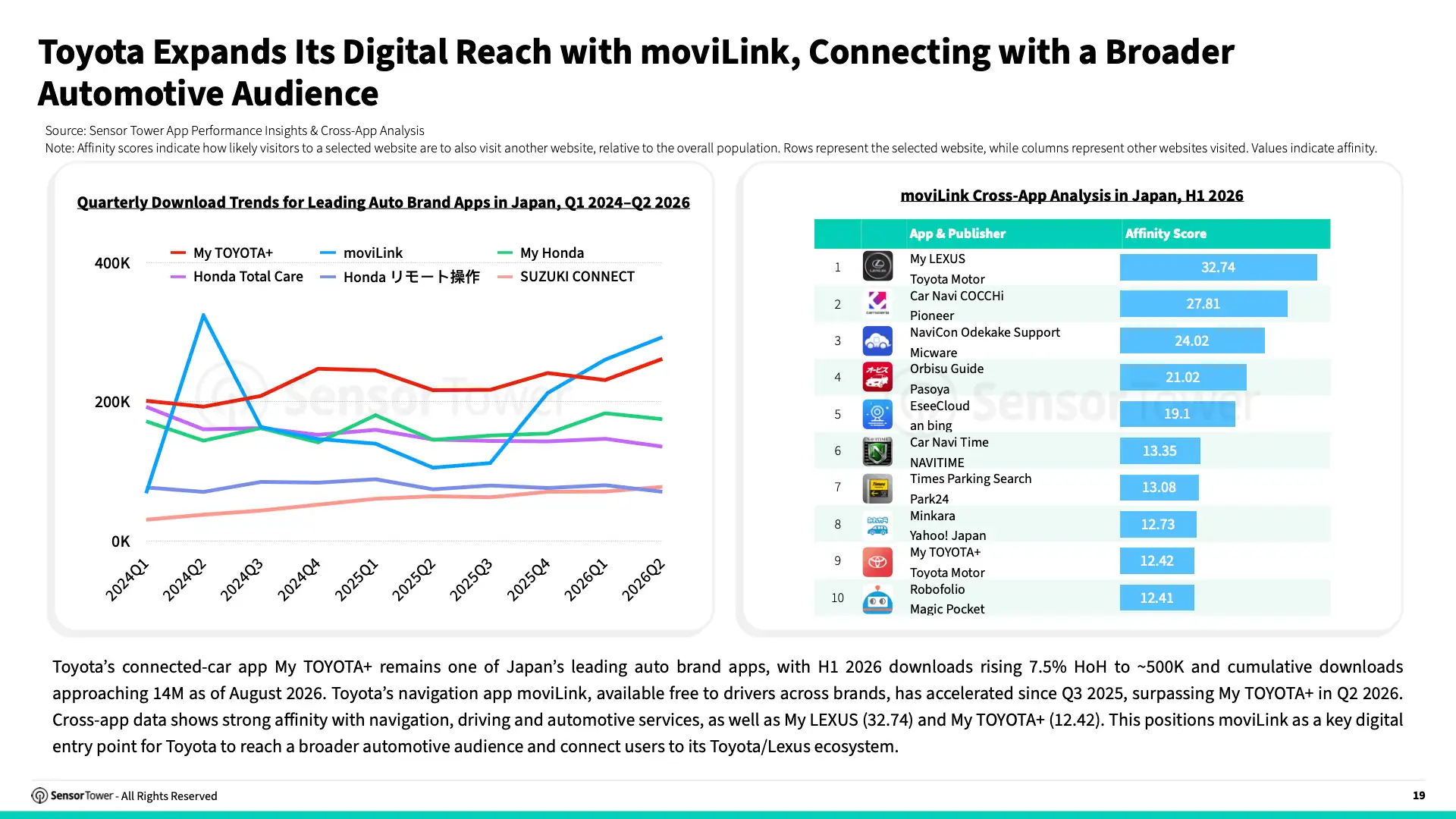
Toyota is leveraging moviLink to reach a broader automotive audience and expand its digital customer acquisition opportunities. Developed as a navigation app tailored to the Japanese market, moviLink has experienced rapid user growth. Cross-app analysis reveals strong user affinity with navigation, driving and automotive digital services, as well as significant overlap with My LEXUS and My TOYOTA+. Beyond navigation, moviLink is evolving into a key digital touchpoint for Toyota to engage a wider automotive audience and connect users to its Toyota/Lexus ecosystem.
South Korea Market: EV Adoption Accelerates as Foreign Brands Intensify Competition for Consumer Attention
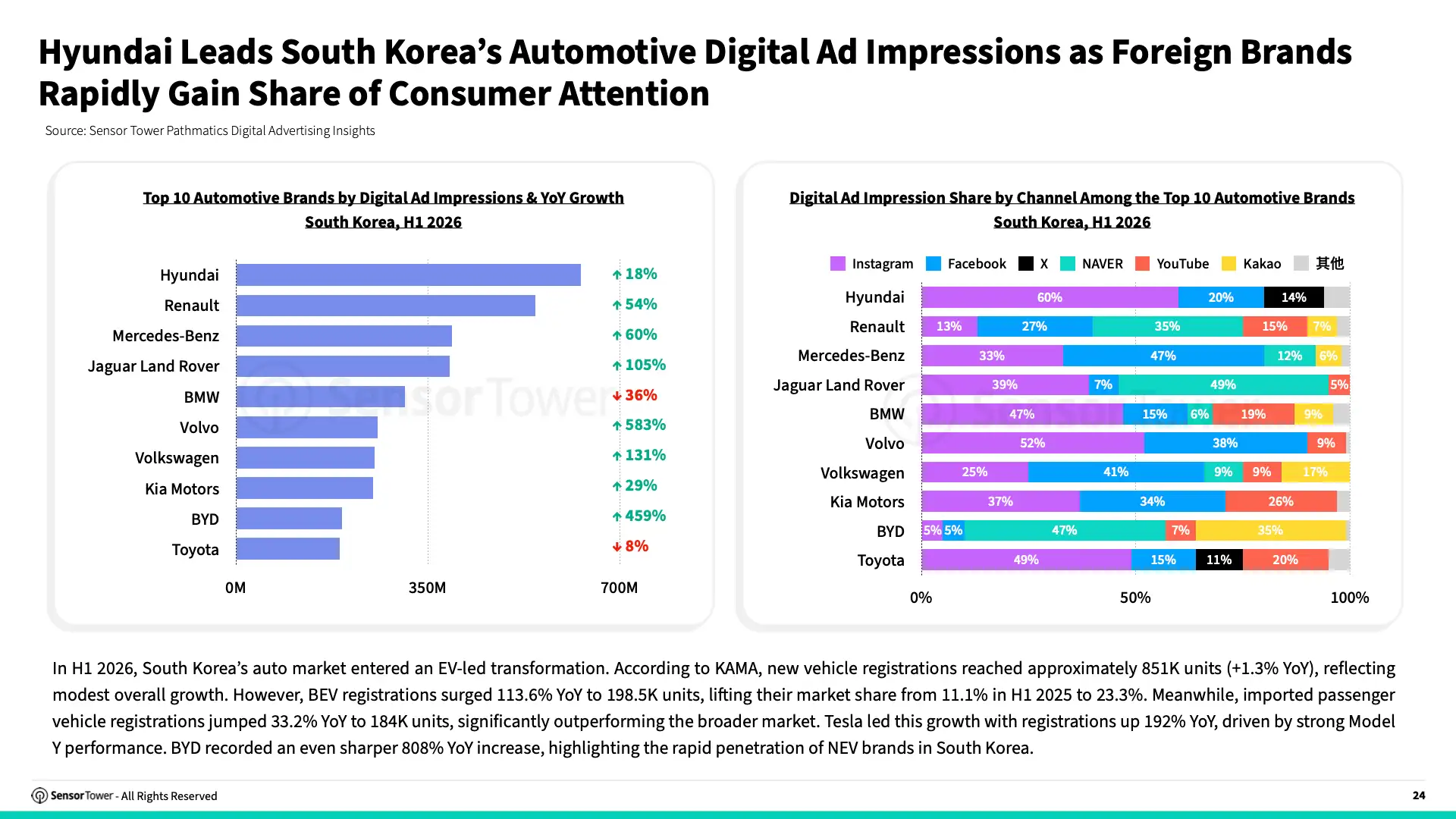
In H1 2026, South Korea's transition toward electric vehicles accelerated, with fully electric vehicle registrations surging 113.6% YoY and market share rising sharply from 11.1% in H1 2025 to 23.3%. Tesla's registrations jumped 192% YoY to 56K units, ranking third behind Kia and Hyundai.
Hyundai continued to lead South Korea's digital advertising landscape with the highest ad impressions, while foreign automotive brands rapidly increased their digital marketing investments to capture a greater share of consumer attention.
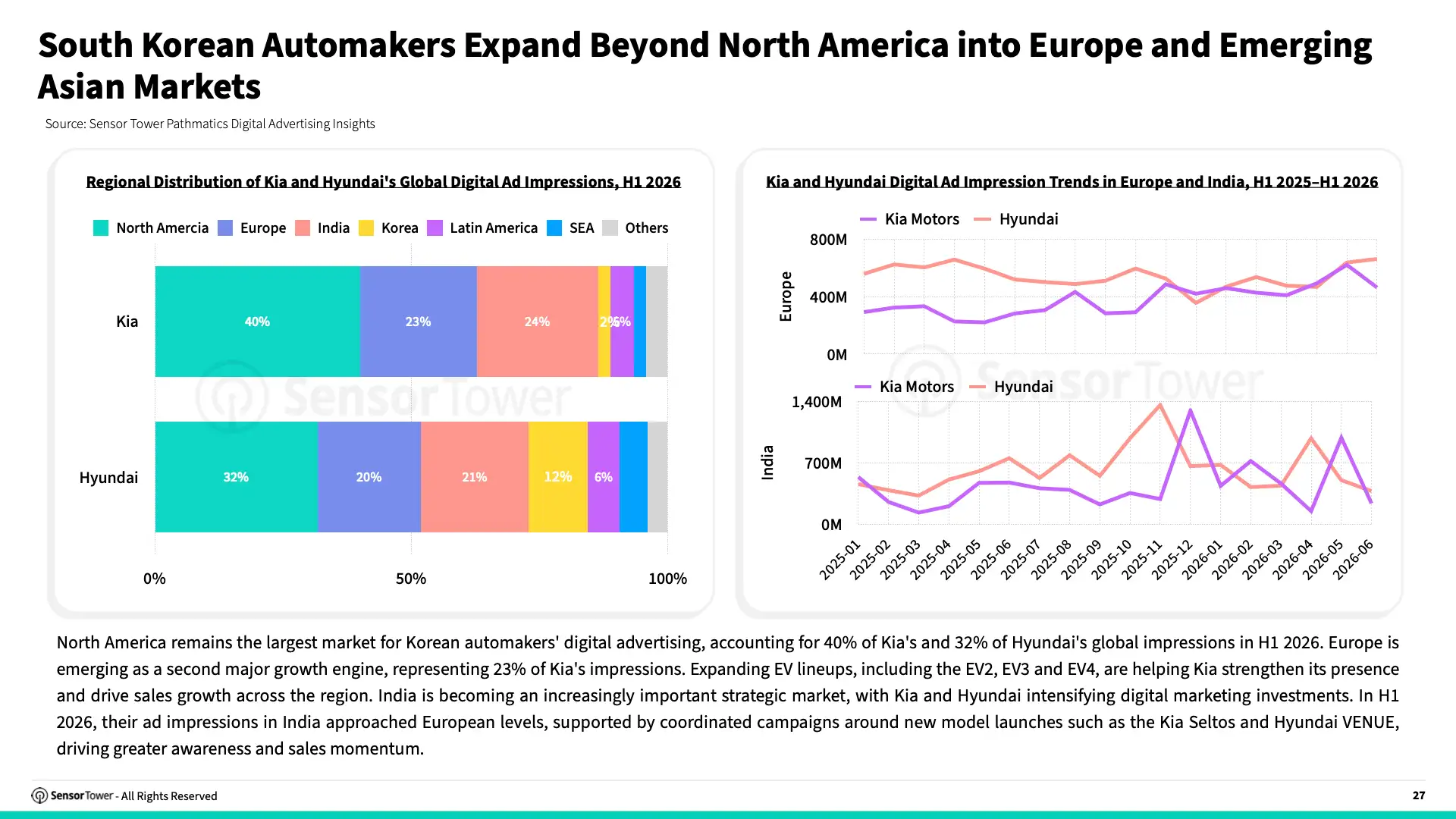
South Korean automakers are diversifying their global expansion strategies across North America, Europe and emerging Asian markets. North America remains their most important market for customer acquisition and brand building, while Europe is emerging as their second-largest digital growth engine. Meanwhile, India is becoming an increasingly important strategic market for South Korean automotive brands globally.
India Market: Domestic Automakers Accelerate Strategic Upgrades as Premium Models Increase Investment in X
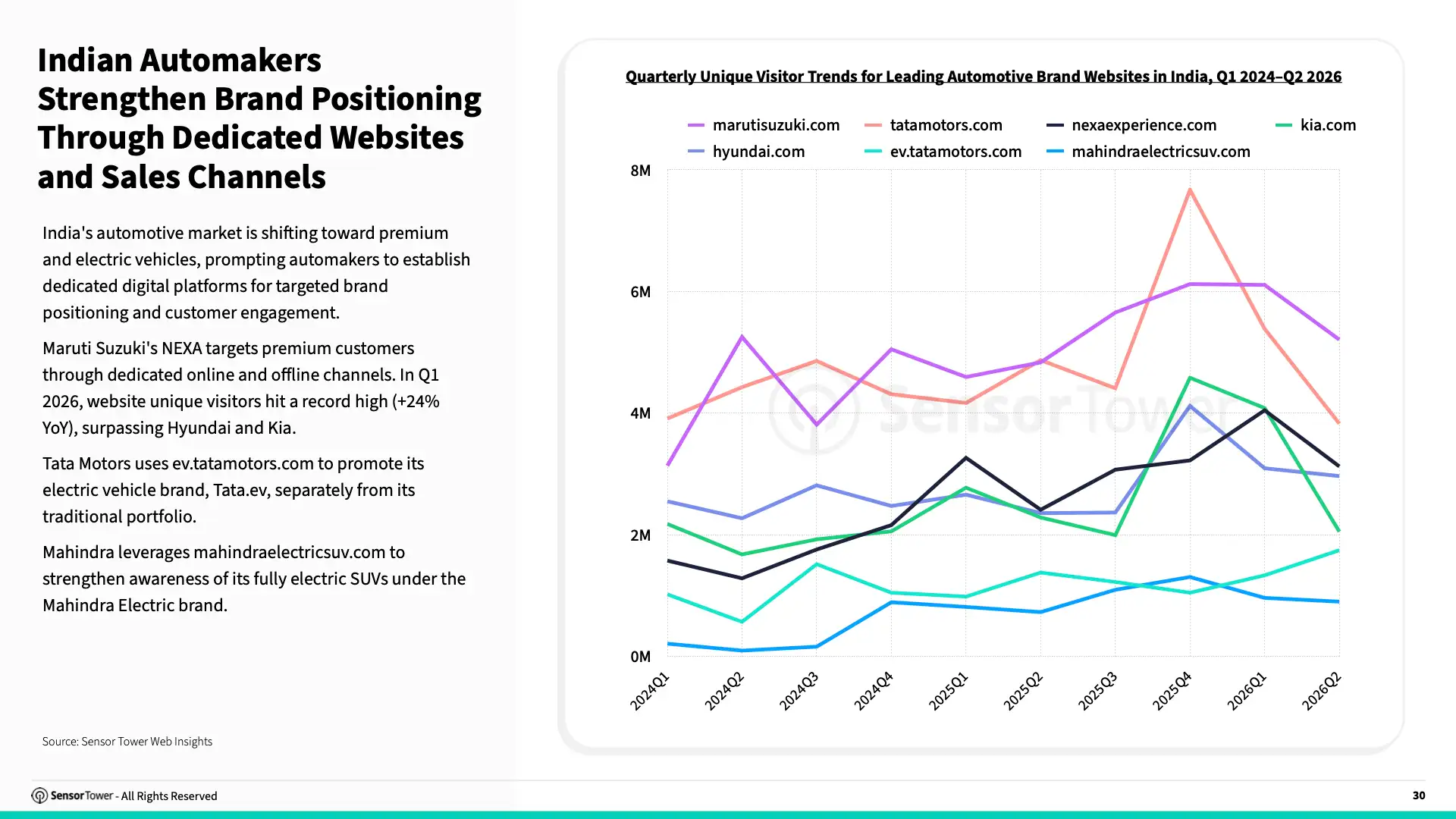
India's automotive market is undergoing a critical phase of product upgrades and energy transition. Leading automakers are establishing dedicated websites and marketing channels for premium sub-brands and new energy vehicle businesses, enabling more targeted brand positioning and customer engagement.
Maruti Suzuki established its premium sales channel, NEXA, targeting new customer segments with innovative technology and enhanced services. NEXA operates through its dedicated website, nexaexperience.com, and physical showrooms, independently of Maruti Suzuki's mass-market ARENA network. In Q1 2026, NEXA's website unique visitors reached a record high, growing nearly 24% YoY, gradually surpassing Hyundai and Kia.
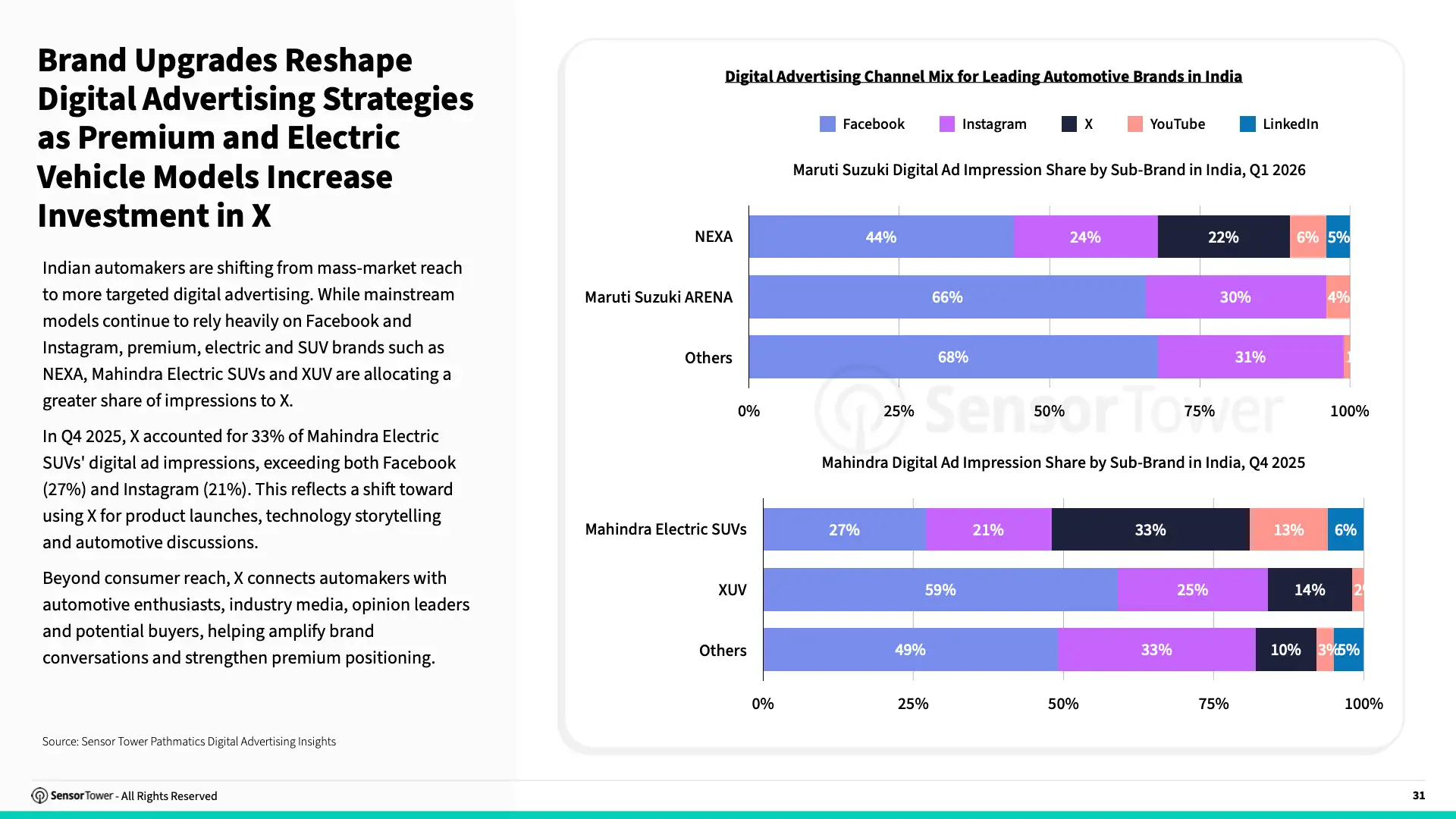
Premium and EV models are increasing their advertising investments on X, as brand upgrades reshape digital marketing strategies. Indian automakers are shifting from mass-market reach to more targeted, segmented messaging. While mainstream models continue to rely heavily on Facebook and Instagram for broad exposure, premium, EV and SUV models such as NEXA, Mahindra Electric SUVs and XUV are allocating a greater share of their digital advertising impressions to X.
To explore more insights, click the button below to download the full report.
Sensor Tower provides mobile app, digital advertising and audience intelligence to help you stay ahead of market shifts, outperform competitors and drive sustainable growth. Contact us to request a product demo:
This article was written by Rui Ma, Senior Analyst, APAC at Sensor Tower, and authorised by Nan Lu, VP of Marketing, APAC. Please credit Sensor Tower if you wish to reprint or share this content.
Sensor Tower – Your Guide to Global Mobile App Growth
Press Inquiries: press-apac@sensortower.com
Business Inquiries: sales@sensortower.com
Reproduction Notice: Please credit Sensor Tower as the source if you share or republish this content.
