
Gaming Insights · Mobile App Insights · Web Insights · Digital Advertising Insights · Sam Aune · July 2026
H1 2026 Digital Gaming Market Index: Mature Markets, Tougher Ads, and a World Cup Lift
H1 2026 was a mature half for digital gaming. Mobile IAP revenue and time spent, PC/console copies sold, and browser visits were all relatively flat versus H1 2025, even as mobile downloads continued to fall. Conversely, advertising moved in the opposite direction. Sensor Tower’s H1 2026 Gaming Digital Market Index tracks the half across mobile, PC/console, browser, and digital advertising as the industry heads into a louder H2.
Want to skip straight to the full report? Download here.
H1 2026 did little to rewrite the structure of the gaming market, but it did clarify the operating conditions. Spending and playtime held up, the install funnel kept tightening, and ad budgets kept climbing. In a half like that, the more useful question is not whether the category “grew,” but which titles, genres, and calendar events still created movement inside a largely mature market.
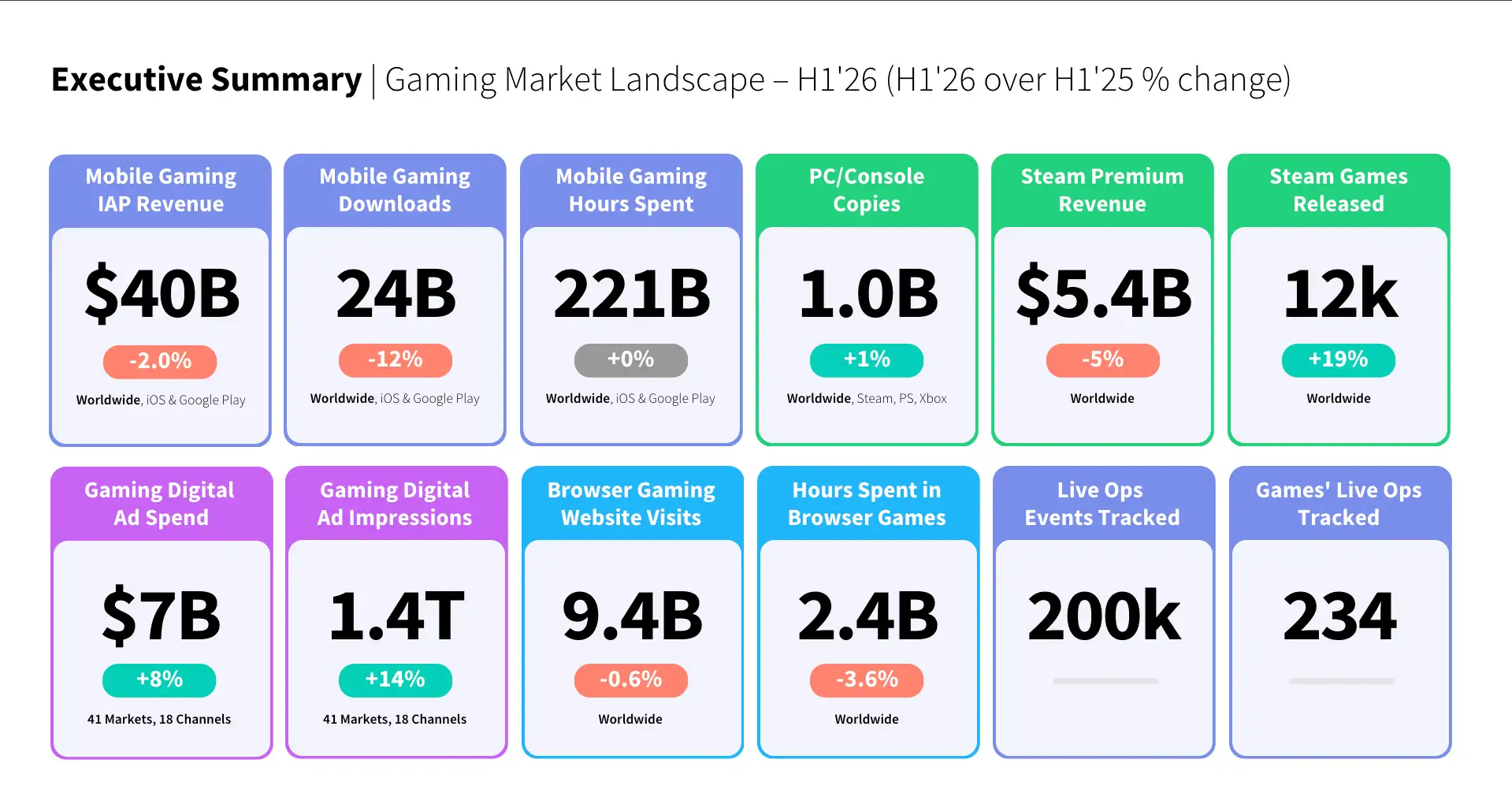
The cross-platform snapshot shows the pattern clearly. Worldwide mobile IAP finished around $40B, down 2% year over year, while mobile playtime held at 221B hours. Downloads told a different story, falling 12% to 24B. PC/console copies sold reached about 1.0B (+1%), even as Steam premium revenue slipped 5% to $5.4B amid a 19% jump in Steam releases to roughly 12,000 titles, indicating an increase in development accessibility and speed. Browser visits remained near flat at 9.4B. Advertising was the clearest point of pressure: impressions rose 14% to 1.4T and spend grew 8% to $7B. With engagement broadly unchanged, that increase points to a more contested media market rather than a larger audience.
Mobile IAP stayed inside the $38–42B half-year range that has defined the market since 2024, landing at $39.8B versus $40.6B in H1 2025. Mid-core remained the largest class at about $20.6B, but fell roughly 7% year over year and sits well below its 2021 H1 peak of $26.6B. One key trend underpinning this was Last War:Survival turning off UA altogether during the half. Casual held near $16.5B, while hybridcasual continued to expand, rising about 23% to $2.4B. Time spent was almost unchanged, with minor declines in mid-core and casual largely offset by gains in hypercasual. In other words, monetization and engagement proved more resilient than acquisition. That context also helps explain why football titles and World Cup live ops mattered in H1: they were among the few mobile areas that still grew, while downloads broadly contracted.
On PC and console, unit sales remained concentrated among familiar publishers, and the World Cup helped decide the top of the board. Electronic Arts led with 63.3M units, powered by EA SPORTS FC 26, the best-selling game of the half despite launching before H1 began. Ubisoft followed at 43.8M, ahead of Capcom (39.2M), Sony Interactive Entertainment (37.5M), and Xbox Game Studios (37.2M). After that tier, volumes fell into the mid-to-low teens for Bandai Namco, 2K, Valve, Activision, and Rockstar Games. U.S. publishers dominated the top 10 by both count and scale, Japan held a strong second position, and Europe looked thinner, represented mainly by Ubisoft. Set against a strong H1 2025 and with GTA VI still ahead, the half reads less like underperformance and more like a catalog-led market waiting on its next major release cycle. Taken together, H1 2026 looks like a mature gaming market under tighter advertising pressure. Mobile revenue and playtime held while downloads fell. PC/console stayed catalog-led and comparatively flat versus a strong year-ago half, with GTA VI still to come. Browser traffic remained concentrated in a handful of sites. The World Cup was one of the few forces that cut across those patterns, lifting FC 26 on PC/console and giving football games and Cup-themed mobile events room to grow. For planning purposes, the half is less a breakout story than a baseline: stable demand, selective growth, and a more competitive fight for attention heading into H2.
Download the full H1 2026 Gaming Digital Market Index, including:
Which leading mobile subgenre is cooling off, and which one nearly doubled
World Cup live ops beyond sports games
A breakdown of arrow puzzle games, which one is pulling ahead of its competitors, and why
The best-selling PC/console games of the half
Browser gaming market trends by region, device, and traffic source
Mobile competitive landscapes, retention benchmarks, ad monetization and network concentration, UA creative leaders, Steam’s premium cooldown, and YouTube’s role in gaming advertising
Key Takeaways:
Mobile IAP and time spent, PC/console copies sold, and browser visits were relatively flat H1 2026 vs H1 2025, while mobile downloads kept falling.
Gaming ad impressions and spend rose even as engagement stayed flat, raising the cost of competing for player attention.
Flat PC/console results against a strong H1 2025 look like consolidation ahead of GTA VI in H2, not a warning sign.
The World Cup cut through the flat half: EA SPORTS FC 26 was the best-selling PC/console title despite launching before H1, and football games plus Cup-themed mobile events still found growth.